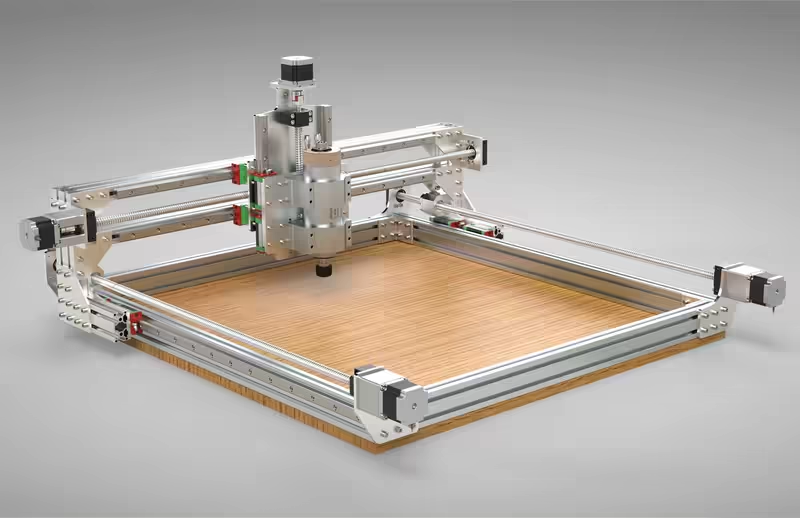
3-Axis Wood CNC Router Machine
A production wood CNC router machine with an 850 × 940 × 95 mm work area and a 2.2 kW air-cooled spindle. Closed-loop stepper motors and ground ball screws on every axis, riding on LM linear guides, in a frame built from aluminium profile and solid machined aluminium blocks. The whole machine runs from a handheld pendant that writes the G-code itself — no PC at the machine. Optionally connects to the karmyogi.hjlabs.in browser workbench. Made in Gandhinagar, India.
Technical Specifications
| X-axis travel | 850 mm |
| Y-axis travel | 940 mm |
| Z-axis travel | 95 mm |
| Spindle | 2.2 kW air-cooled |
| Motors | Rtelligent 85 kg·cm closed-loop stepper motors on X, Y and Z — Z fitted with a holding brake |
| Transmission | Ball screws on all three axes |
| Linear motion | LM linear guide rails on all axes |
| Frame | Aluminium extrusion profile with solid machined aluminium blocks at load-bearing joints |
| Control | Handheld pendant with on-machine G-code generation — no PC required |
| Optional control | karmyogi.hjlabs.in browser workbench over Web Serial |
| Bed | Flat work surface, custom fixturing and spoilboard options on request |
| Work envelope | 850 × 940 × 95 mm (33.5 × 37 × 3.7 in) |
| Spindle cooling | Air-cooled — no pump, reservoir or coolant lines |
| Typical materials | Hardwood, softwood, plywood, MDF/HDF, acrylic, polycarbonate, ACP and composite panel, PCB and phenolic, model board, tooling foam; light aluminium with the right cutters and workholding |
| Price | ₹2,75,000 + GST (shipping quoted separately) |
| Availability | Built to order — lead time confirmed on the quotation |
| Return window | 7 calendar days from delivery on the standard build — see return policy |
| Warranty | 12 months against manufacturing defects, per hjLabs.in Terms & Conditions |
| Built in | Gandhinagar, Gujarat, India |
Installation & Facility Requirements
Everything an engineer or a plant manager needs to plan the installation before the machine arrives — supply, footprint, weight and the drive components actually fitted.
| Supply voltage | 230 V AC, single phase, 50 Hz. Other supply voltages and frequencies can be built to order for export — confirmed on the quotation. |
| Spindle drive | 2.2 kW air-cooled spindle on a VFD with speed and direction control (Aeromotion VFD, Triquench spindle motor) |
| X and Y axis motors | Rtelligent 85 kg·cm closed-loop stepper |
| Z axis motor | Rtelligent 85 kg·cm closed-loop stepper with holding brake |
| Machine footprint | 1500 × 1500 × 800 mm (width × depth × height) |
| Electrical panel footprint | 900 × 350 × 950 mm (width × depth × height) |
| Gross weight | Approximately 80 kg |
| Collet range | 3 mm to 13 mm collet set; other sizes on request |
| Tooling supplied | 40-piece end mill and engraving bit set, 3.175 mm shank |
| Axis travel basis | The 850 × 940 × 95 mm figures are actual usable travel, not ball-screw or frame length |
Dimensional and electrical figures are standard build values given to help you plan the installation. Component makes may be substituted with equivalents of the same rating. Final specification, achievable cycle times and suitability for a given material, cutter and fixturing depend on your application and are confirmed on the quotation and at pre-dispatch testing.
No PC at the Machine

Most CNC routers in this class come with an unspoken extra cost: a computer. A tower or laptop has to live next to the machine, run a control program, keep a driver working, and survive the dust. When it fails on a Tuesday morning, the machine is not a machine any more — it is furniture.
This router is built the other way round. The handheld pendant is the control system, and it generates the G-code on the machine itself. The operator enters the geometry and the cutting parameters on the pendant, and the pendant produces and runs the toolpath. Nothing is exported from a CAM seat, nothing is carried over on a USB stick, and nothing depends on a Windows machine staying healthy.
This is the same pendant hardware and the same design philosophy we use on the 3-Axis Selective Soldering Robot — adapted for routing work rather than soldering. It is a decision we keep making deliberately, because it is the difference between an operator who can run the machine on day one and an operator who needs a CAM course first.
The practical result is that the person who knows the material can run the machine. A carpenter who understands feeds and grain does not need to become a CAD technician to cut a panel.
Built for Rigidity: Ball Screws, LM Guides, Closed-Loop Drives
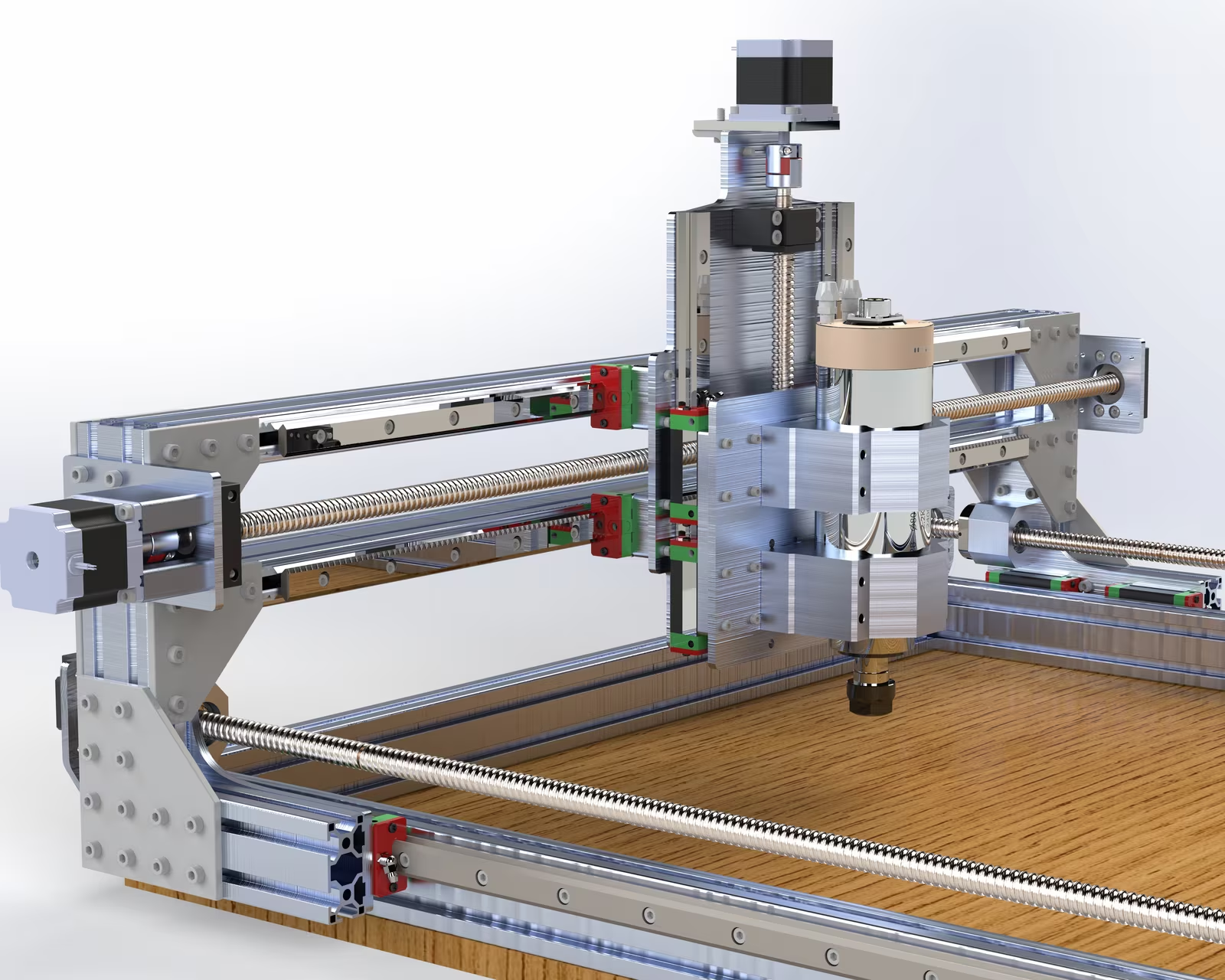
Precision on a router is decided by three things: what drives the axis, what guides it, and what holds it all still. This machine does not compromise on any of the three.
Ball screws on all three axes. Not belts, not lead screws. A belt drive stretches under cutting load and gives up position; a plain lead screw has backlash that shows up the moment the cutter changes direction. Ground ball screws remove both problems, which is what lets a repeat cut land where the first one did.
LM linear guide rails. Recirculating-ball linear guides carry the cutting loads instead of the drive screw, and they resist the twisting moment a router generates when it takes a deep side pass. Rails on all axes is what keeps the spindle perpendicular under load rather than deflecting into the cut.
Closed-loop stepper motors. A plain open-loop stepper has no feedback: if it loses steps under load, nothing notices and the part is scrap. These drives carry an encoder on the motor shaft, so the drive knows the true position and corrects it continuously. On a machine with a 2.2 kW spindle taking real cuts in hardwood or aluminium, that closed loop is what keeps a two-hour job dimensionally honest from the first pass to the last.
Aluminium profile plus solid aluminium blocks. The frame uses extrusion where stiffness-per-kilo matters and solid machined aluminium at the load-bearing joints, where a profile connector would flex. It is a deliberate mix, not a cost decision.
2.2 kW Air-Cooled Spindle
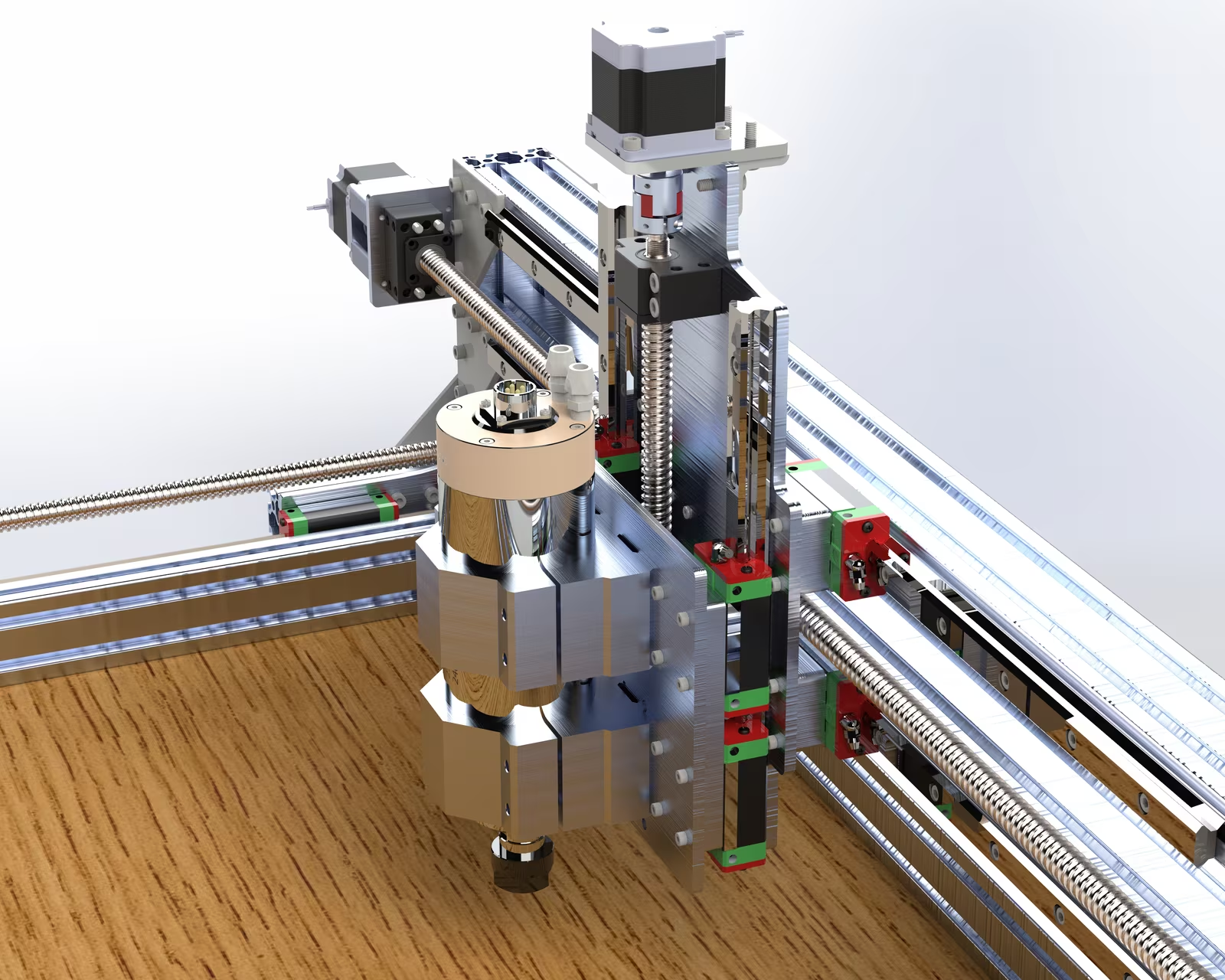
The 2.2 kW air-cooled spindle is the practical sweet spot for a machine this size. It has the torque to take a real depth of cut in hardwood, plywood and MDF, and enough top-end speed for clean finishing passes in acrylic and composite panel.
Air-cooled, deliberately. A water-cooled spindle means a pump, a reservoir, coolant lines across a moving gantry, and a failure mode where a leak or a dry pump quietly destroys the spindle. Air cooling removes the entire subsystem. There is no water to top up, nothing to freeze in winter, and one less thing to check before a shift.
The spindle is clamped in solid machined aluminium blocks rather than a folded bracket, so the cutting forces go into the structure instead of into a mount that flexes. The Z axis carrying it runs on its own ball screw and LM guides, the same as X and Y.
Optional: Drive It From Your Browser
The pendant is designed so you never need a computer. But when you want one — for a 3D toolpath preview on a large screen, or to lay out a nested sheet before cutting — the machine connects to karmyogi.hjlabs.in, our browser-native CAD/CAM and machine-control workbench.
karmyogi talks to the controller directly over Web Serial. There is nothing to install, no driver, no licence server and no cloud round-trip — your design files never leave your computer. It runs the same workbench used for CNC carving, laser cutting, pen plotting, PCB isolation routing and auto-soldering, so one interface covers every hjLabs machine on your floor.
The intended workflow is that both live side by side: the pendant for everyday production at the machine, the browser workbench when a job needs planning or visualisation first.
Woodworking Applications: Furniture, Signage and Carving
With an 850 × 940 mm work area, the machine takes a full furniture component or signage panel without repositioning the workpiece. It is used most often for woodworking — hardwood, plywood and MDF — and handles the following work:
- Furniture and joinery — cabinet parts, door skins, drawer fronts, jig and template cutting, dowel and shelf-pin drilling patterns.
- Signage and display — acrylic and ACP letter cutting, engraved plaques, backlit panel work, exhibition fixtures.
- Pattern and mould work — model board and tooling foam patterns, vacuum-forming bucks, sand-casting patterns.
- Electronics and prototyping — PCB isolation routing, enclosure cut-outs, panel drilling, front-panel engraving.
- Light aluminium work — plates, brackets, fixture bodies and spacers, with appropriate cutters, feeds and workholding.
- Education and training — a machine students can actually operate on day one, because the pendant does not require a CAM seat first.
Not ready to buy a machine for a one-off job? Our sister service ManufacturingHub runs the same class of work as a job shop — upload a DXF, SVG or STL and it returns an instant price for laser cutting and CNC wood carving (3-axis relief, 4-axis rotary, 2D profiling, pocketing and V-carving) with no minimum order. Useful for prototyping a part before you commit to in-house capacity.
What the Machine Includes
- Machine frame — aluminium extrusion profile with solid machined aluminium blocks at every load-bearing joint.
- 850 × 940 × 95 mm work envelope — a flat work surface with custom fixturing and spoilboard options available on request.
- Ball screws on X, Y and Z — not belts, not plain lead screws.
- LM linear guide rails on all three axes — recirculating-ball guides carry the cutting load instead of the drive screw.
- Closed-loop stepper motors on all three axes — encoder feedback, so lost position is corrected rather than silently accepted. The Z-axis motor carries a holding brake.
- 2.2 kW air-cooled spindle — clamped in solid aluminium blocks, driven on the Z ball screw.
- Handheld pendant — the complete control system, generating G-code on the machine. No PC, no dongle, no licence server.
- Optional browser control — connect to karmyogi.hjlabs.in over Web Serial when you want a 3D toolpath preview on a big screen.
Quoted separately: custom bed sizes, alternative spindle options, job-specific fixturing and spoilboard arrangements. Tooling, collets and cutters are selected for the material you actually cut, so we quote them with the machine rather than shipping a generic set.
What It Replaces
Most workshops arrive at a CNC router from one of three places. It is worth being clear about which one you are in, because the payback looks different in each.
| Hand routing / jig and template | This machine | Outsourced job shop | |
| Repeatability | As good as the template and the operator | Ball screws and closed-loop drives on all axes | Good, but not under your control |
| Turnaround on a change | Cut a new template | Edit on the pendant, re-run | Re-quote and re-queue |
| Cost per part | Labour-dominated | Material, cutter and machine time | Per-part price plus freight |
| Skill required | High craft skill | Material knowledge; the pendant does the CAM | None |
| Capital | Low | ₹2,75,000 + GST | None |
| Best for | One-offs, bespoke joinery | Repeat panels, batches, in-house iteration | Occasional or oversized jobs |
The fourth option — a PC-driven router in the same price bracket — is the one this machine is designed against directly. The difference is not the cutting; it is that the control system does not depend on a computer that has to be kept alive, driver-compatible and dust-free next to a spindle throwing chips. See No PC at the Machine above for why we build it this way.
The Work Envelope in Practical Terms
Numbers on a spec sheet do not tell you whether your part fits. Here is what 850 × 940 × 95 mm means on the floor.
- In inches — 33.5 × 37 × 3.7 in. Close to a three-foot-square panel, slightly deeper on Y than on X.
- Against a standard 8 × 4 ft sheet — a full sheet does not fit, and no machine at this price does. What fits is a cut-down blank: quarter and third sheets, cabinet sides, door skins, shelf and drawer components. Most joinery shops break the sheet down on a panel saw first anyway.
- On Z — 95 mm of travel is the axis stroke, not the maximum stock thickness. Usable material depth is what is left after the collet, the cutter stick-out and your workholding, so plan the cutter length around the part rather than the other way round.
- Fixturing — the work surface takes custom fixturing and spoilboard arrangements on request. For repeat batch work, a dedicated fixture is what turns a good machine into a fast one.
If the panels you actually cut are consistently larger than this, say so at enquiry. The frame architecture scales and we quote the machine around your panel size rather than selling you the standard build and hoping.
Living With the Machine
A router earns its keep over years, so the honest questions are about the second year, not the first week.
Air cooling removes a whole maintenance system. There is no pump to fail, no reservoir to top up, no coolant to freeze in winter, and no line to burst across a moving gantry. A water-cooled spindle is not worse at cutting; it is worse at being ignored, and shop equipment always ends up being ignored.
Ball screws and LM guides want grease, not attention. Recirculating-ball components are lubricated on a schedule and otherwise left alone. Because the guides carry the cutting load rather than the screws, the screws stay accurate for far longer than a machine that makes the drive do both jobs.
The spoilboard is a consumable, and that is by design. Resurfacing it flat is a routine job and it is what keeps through-cuts consistent across the bed.
The drives tell you when something is wrong. A closed-loop drive that cannot reach the commanded position faults instead of quietly scrapping the part — which on a two-hour job in expensive stock is the difference between a fixable problem and a wasted sheet.
The control system updates without a technician. The pendant is the controller, so there is no Windows version to stay compatible with and no CAM licence to renew for the machine to keep running.
Price, Ordering and Support
The machine is ₹2,75,000 + GST, built to order in Gandhinagar, Gujarat. Shipping is quoted separately because it depends on destination, weight and volume; larger machines commonly move freight-on-road, which we coordinate directly. Full terms are on the shipping policy page. Comparing quotations from several makers? Our CNC wood router price guide for India lists the seven components that change a router's price and what quotations usually leave out.
The machine carries the standard hjLabs.in machine warranty — 12 months against manufacturing defects. Lead time is confirmed in writing on the quotation before the build starts, because a custom bed size or an alternative spindle changes it. The standard build may be returned within 7 calendar days of delivery if unused and in original packaging, with return shipping at the customer's cost; see the return and refund policy.
To get a firm quote, tell us the panel size you cut, the materials, and whether you need custom fixturing. Reach us through the contact page, on WhatsApp, or by describing a non-standard build through Custom Automation Solutions. Every hjLabs.in machine — this router, the 3-Axis Programmable Selective Soldering Robot, the spring coiling machine — is designed, built and supported from the same workshop, which is why a firmware question does not become a supply-chain question.
Frequently Asked Questions
What is the work area of this 3-axis CNC router?
850 mm of travel on X, 940 mm on Y and 95 mm on Z — 33.5 × 37 × 3.7 inches, close to a three-foot-square panel. That is enough to take a full furniture component, signage panel, door skin or mould pattern without repositioning the workpiece.
Do I need a computer to run this CNC router?
No. The handheld pendant generates the G-code on the machine. You enter the geometry and cutting parameters on the pendant and it produces and runs the toolpath. There is no PC, no dongle and no laptop to keep alive next to the machine.
Why closed-loop steppers instead of open-loop steppers?
A closed-loop stepper carries an encoder on the motor shaft, so the drive knows the true position and corrects for it. A plain open-loop stepper has no such feedback: if it loses steps under load nothing notices and the part is scrap. On a 2.2 kW router taking deep passes, closed-loop control is what keeps a long job dimensionally honest.
What materials can it cut?
Hardwood and softwood, plywood, MDF and HDF, acrylic and polycarbonate, ACP and composite panel, PCB and phenolic, model board and tooling foam. With the right cutters, feeds and workholding it also handles light aluminium work such as plates, brackets and fixture bodies.
What is the price of this CNC router in India?
₹2,75,000 plus GST, built to order in Gandhinagar, Gujarat. Shipping is quoted separately because it depends on destination, weight and volume. Custom bed sizes and spindle options are quoted on request.
Can I connect it to a computer or app?
Optionally, yes. The pendant is self-sufficient, but the machine also connects to karmyogi.hjlabs.in over Web Serial — a browser-based CAD/CAM and control workbench with nothing to install and no file ever leaving your computer.
What ball screws and guides are used?
Ball screws on all three axes rather than belts or lead screws, riding on LM linear guide rails. The frame combines aluminium extrusion with solid machined aluminium blocks at the load-bearing joints. Ball screws remove the backlash and stretch that a belt drive introduces.
Can the bed size be customised?
Yes. The 850 × 940 mm work area is the standard build, but the frame architecture scales. Tell us the panel size you actually cut and we will quote the machine around it.
What is included with the machine?
The aluminium-profile frame with solid machined aluminium blocks at the load-bearing joints, ball screws and LM linear guides on all three axes, closed-loop stepper motors on all three axes, the 2.2 kW air-cooled spindle, the flat work surface, and the handheld pendant that acts as the complete control system. Custom bed sizes, alternative spindles, cutters and job-specific fixturing are quoted separately.
Does a full 8 × 4 ft sheet fit on the bed?
No, and no machine at this price does. The 850 × 940 mm envelope takes a cut-down blank — quarter and third sheets, cabinet sides, door skins, drawer and shelf components — which is how most joinery shops work anyway, breaking the sheet down on a panel saw first. If your parts are consistently larger, tell us the panel size and we will quote a machine built around it.
Why an air-cooled spindle instead of water-cooled?
Air cooling removes the entire cooling subsystem: no pump, no reservoir, no coolant lines crossing a moving gantry, nothing to freeze in winter and nothing to check before a shift. A water-cooled spindle is not worse at cutting; it is worse at being ignored, and shop equipment gets ignored.
What is the lead time and warranty?
The machine carries hjLabs.in's standard 12-month warranty against manufacturing defects under normal operating conditions. It is built to order in Gandhinagar, Gujarat, and the lead time for your configuration is confirmed in writing on the quotation, because a custom bed size or an alternative spindle changes it. The standard build may be returned within 7 calendar days of delivery if unused and in original packaging, under the hjLabs.in return policy.
Related Machines
Need a Different Bed Size or Spindle?
Larger work area, water-cooled spindle, vacuum table, automatic tool change or a dedicated fixturing plate for your part — we build custom router variants to order.
Contact Us for Custom Enquiry