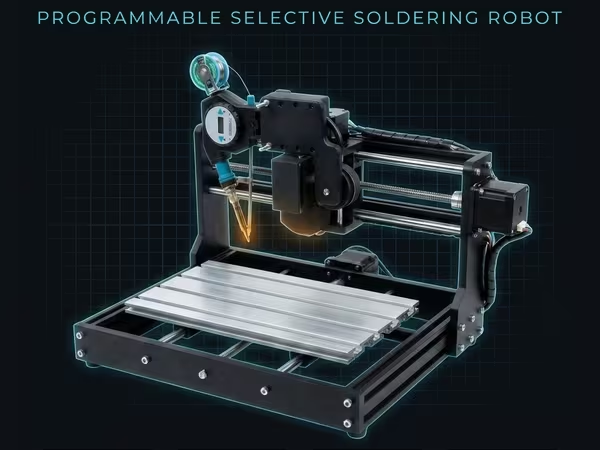
AutoSolder 7 — 3-Axis Programmable Selective Soldering Robot
A selective soldering machine for modern PCB assembly — a programmable 3-axis soldering robot. 180x240mm T-slot work bed, 0.01 mm axis repeatability, temperature-controlled iron (90-480 C), automatic solder-wire feeder, and touch-screen pendant with jog dial. WiFi + wireless OTA firmware updates. Control from the karmyogi.hjlabs.in web app. Made in Gandhinagar, India.
Technical Specifications
| Work Bed | 180 x 240 mm T-slot (custom sizes on request) |
| Repeatability | 0.01 mm (X / Y / Z) |
| Throughput | 3,000 - 5,000 solder points per hour |
| Iron Temperature Range | 90 - 480 °C (temperature-controlled) |
| Solder-Wire Feed | Automatic feeder, programmable feed rate |
| Approach Angles | 4 x 45° plus 90° plunge (programmable per point) |
| Programming | Touch-screen pendant with jog dial (teach & play) |
| Program Storage | On-board SD card — auto-recall after power loss |
| Operator Controls | Play / Pause / Stop plus hands-free foot pedal |
| Connectivity | WiFi (2.4 GHz) — controlled from karmyogi.hjlabs.in |
| Firmware Updates | Wireless OTA — no USB required |
| Controller | Industrial-grade, stepper-driven X/Y/Z |
| Solder Alloys | Lead-free (SAC305), leaded (Sn63Pb37) and low-temperature bismuth alloys — all within the 90–480 °C band, no hardware change |
| Base Price | ₹85,000 + GST (base configuration) |
| Lead Time | Built to order — confirmed on the quotation |
| Shipping (India) | Free on orders above ₹5,000 — see shipping policy |
| Return Window | 7 calendar days from delivery on standard configurations — see return policy |
| Warranty | 1 Year (parts + labour) |
| Custom Options | Larger / bespoke bed, dual head, integrated conveyor, board-specific fixturing (quoted separately) |
| Country of Origin | India (Gandhinagar, Gujarat) |
Built for Precision: Selective Soldering, Point by Point
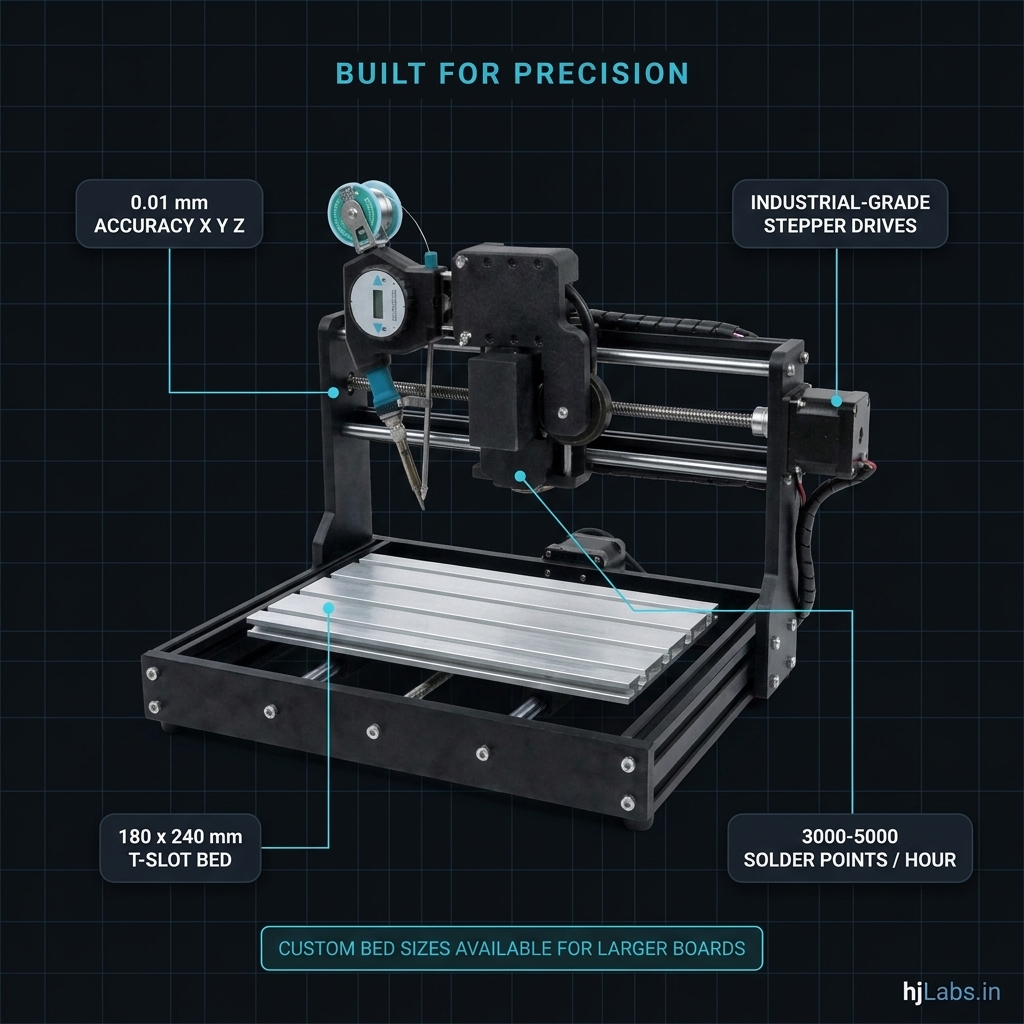
0.01 mm repeatability
Repeatable X, Y and Z positioning — measured, not marketing.
Industrial steppers
Closed-loop stepper drives sized for 24/7 production duty.
180 x 240 mm T-slot bed
Clamp any PCB, jig, or battery pack directly to the aluminium table.
3,000 - 5,000 pts/hr
Sustained throughput on real production BOMs.
Custom bed sizes
Larger boards? Request a bespoke bed at quote.
Smart Soldering Head
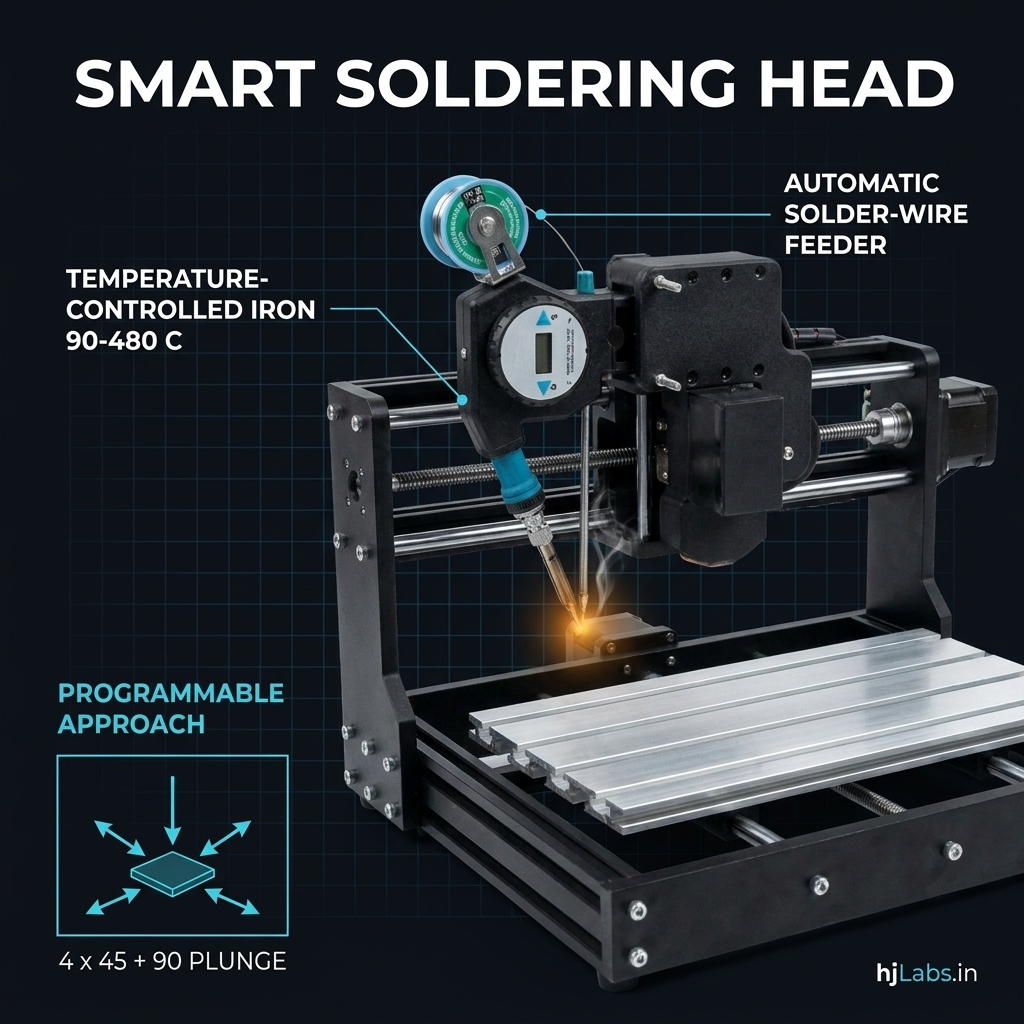
- Temperature-controlled iron — 90-480 °C, covers lead-free (SAC305), leaded, and low-temp alloys.
- Automatic solder-wire feeder — programmable feed rate and per-point volume.
- Programmable approach — four 45° angles plus a 90° plunge, chosen per solder point to clear tall components and reach recessed pads.
- Tip cleaner and fume path integrated with the head assembly.
Program & Control
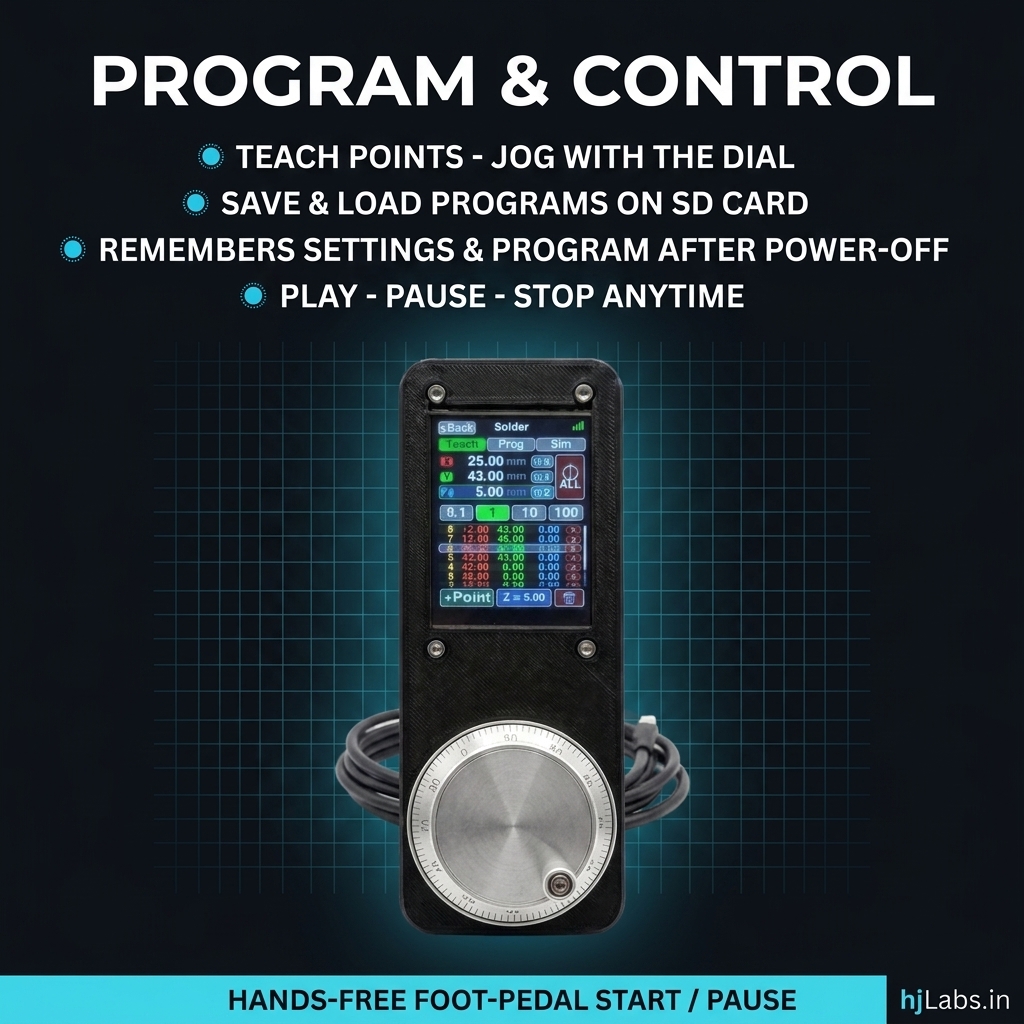
Touch-screen pendant
Familiar interface with a jog dial for precise point teaching.
Teach & play
Jog to a solder point, save; repeat. No CAD import needed.
SD card storage
Load, save, and version programs on removable SD.
Power-loss memory
Settings and the loaded program persist after power-off.
Play / Pause / Stop
Full run-time control from the pendant.
Foot pedal
Hands-free start / pause for two-hand fixturing.
Connected & Upgradable
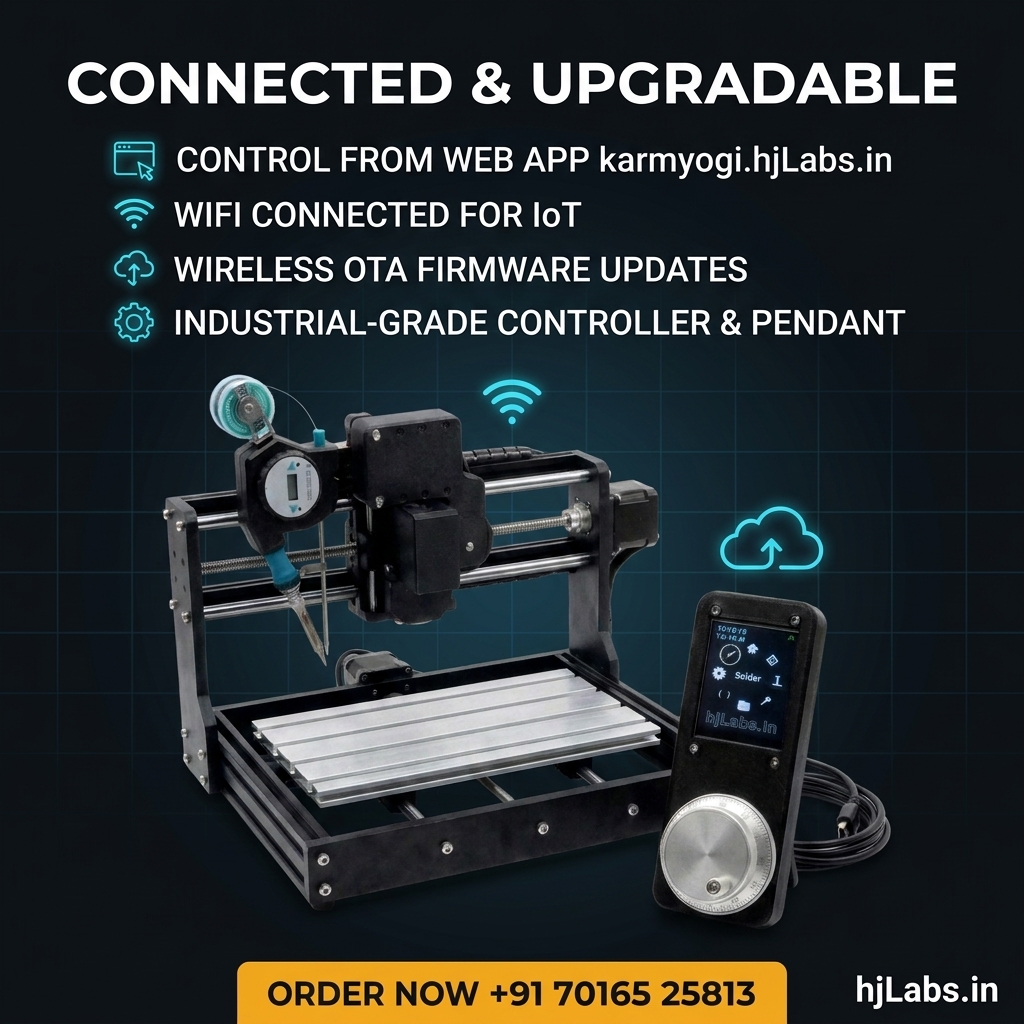
- Web app control — drive the machine from karmyogi.hjlabs.in.
- WiFi enabled — ready for factory IoT dashboards and MQTT hooks.
- Wireless OTA firmware — ship features and fixes without a USB cable.
- Industrial-grade controller and pendant — built for shop-floor conditions.
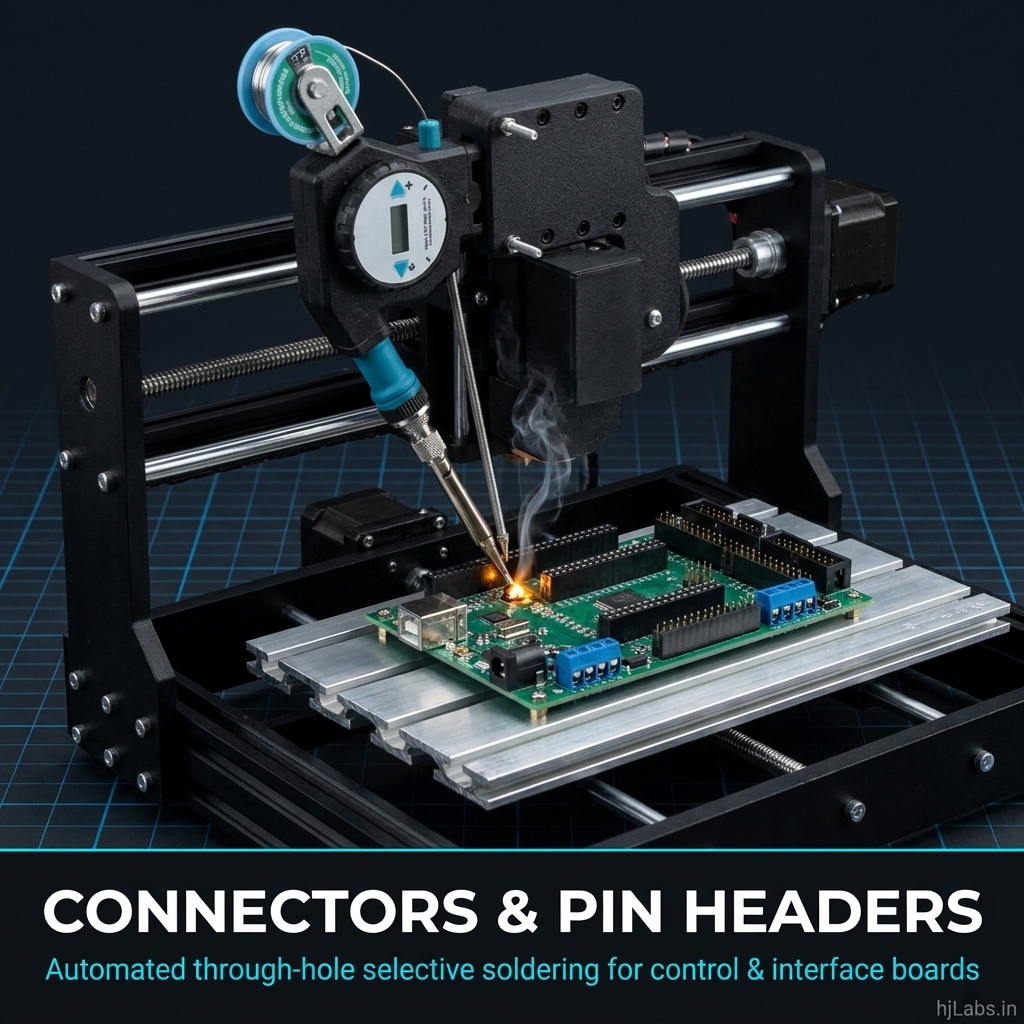
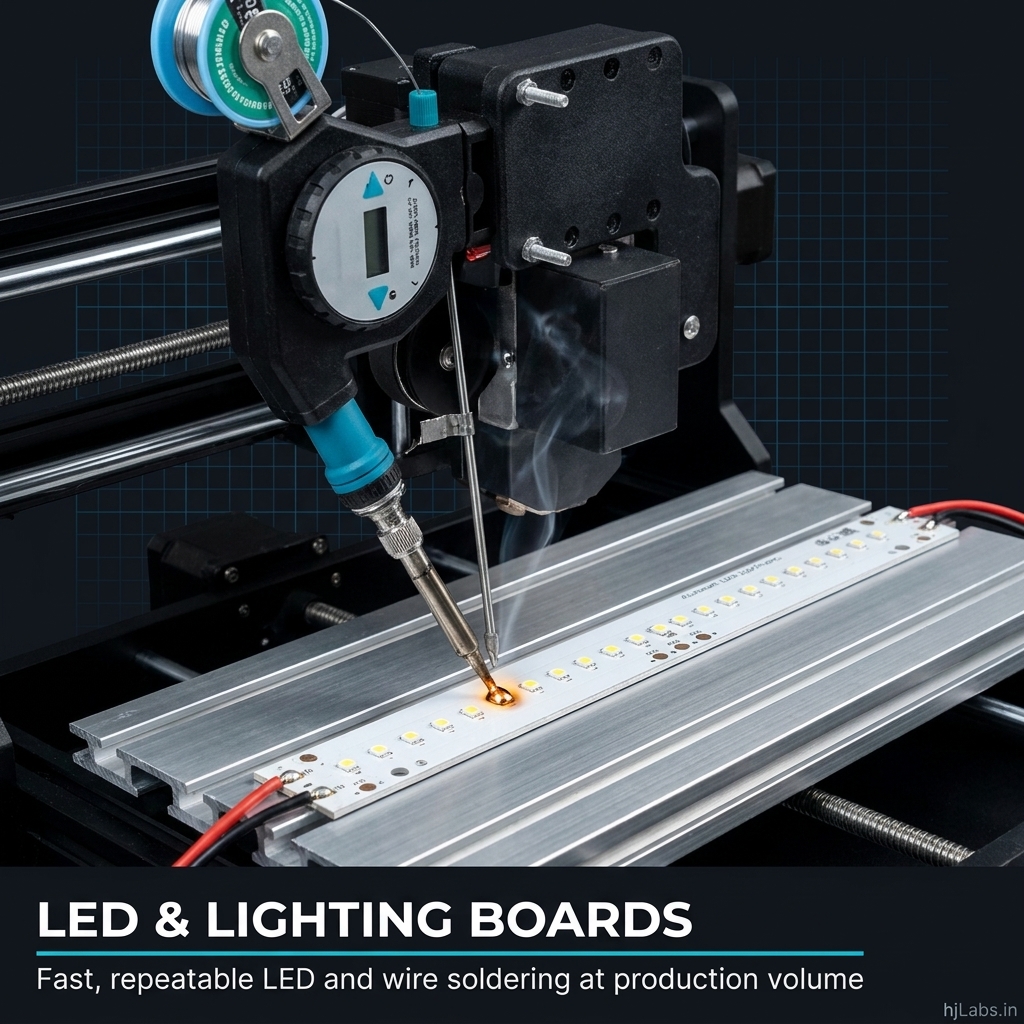
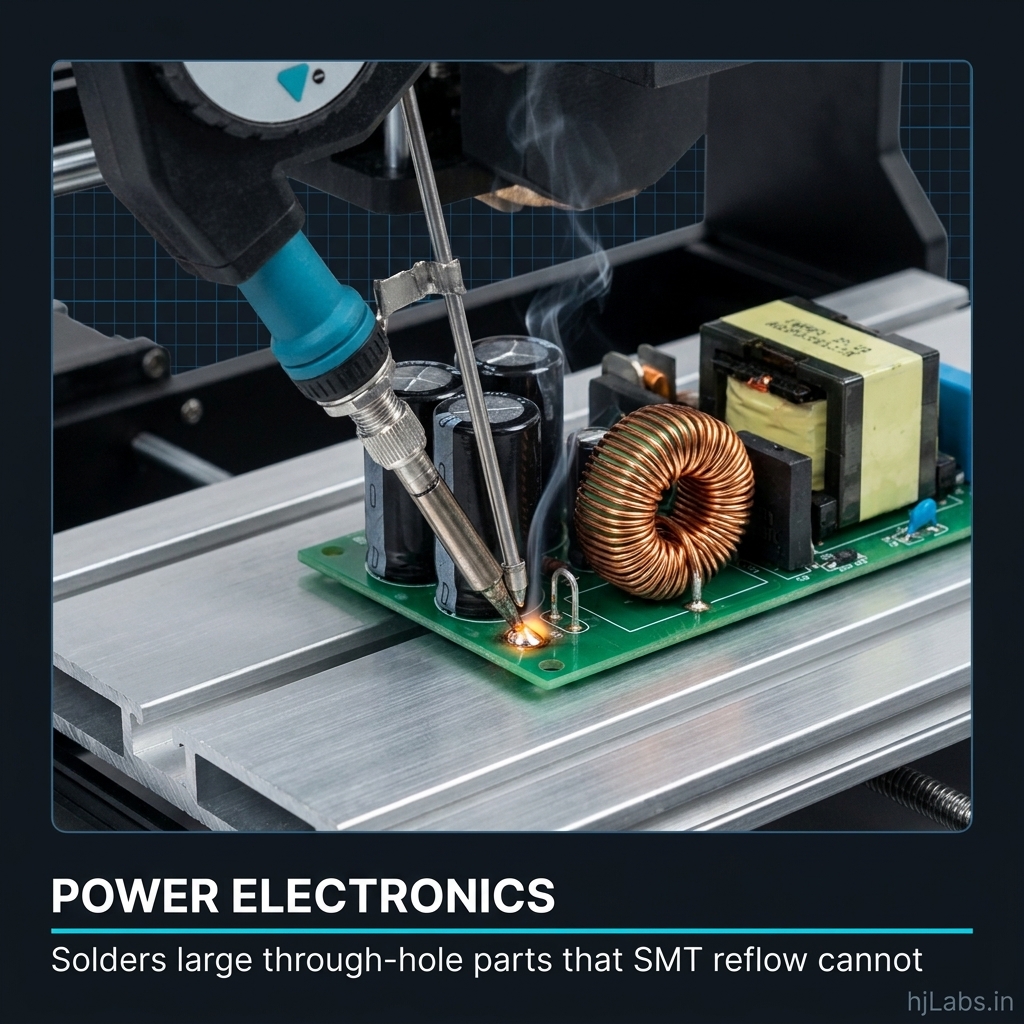
Where a Selective Soldering Machine Earns Its Place
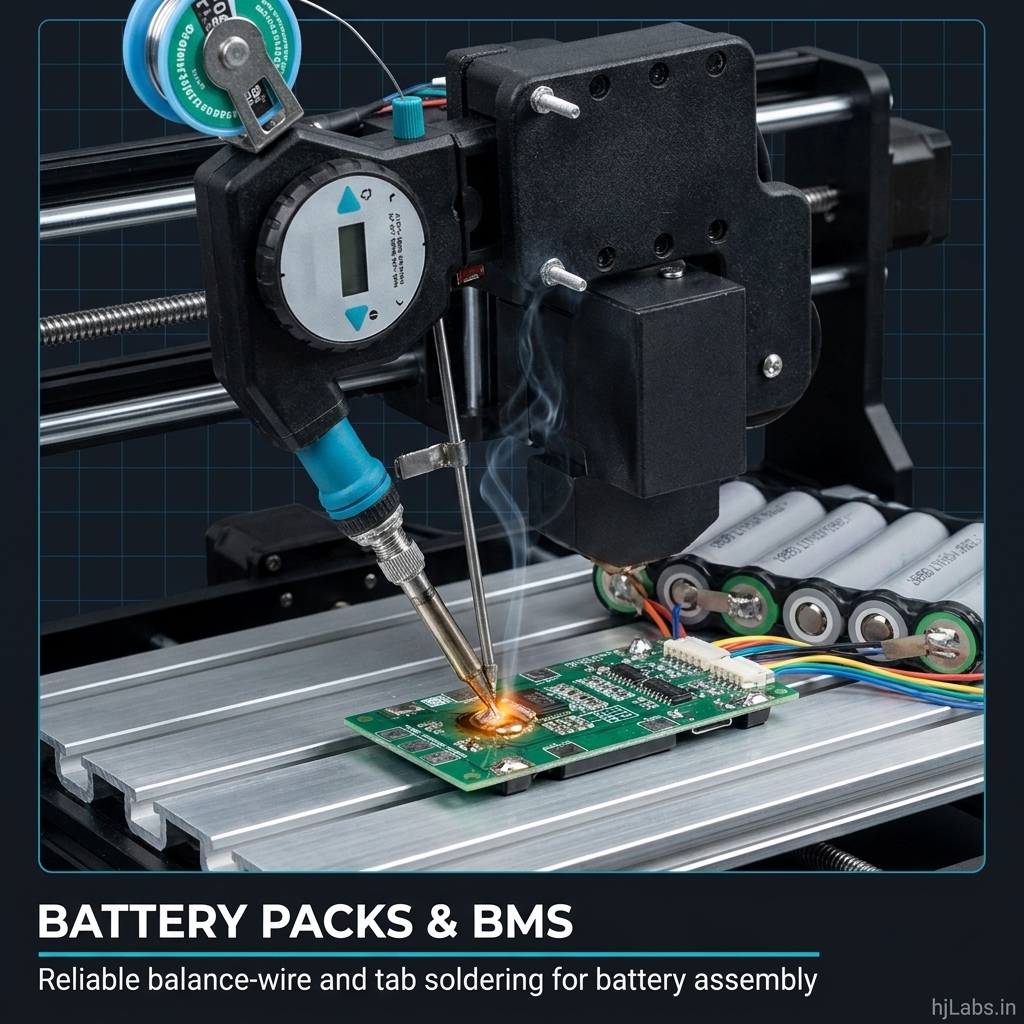
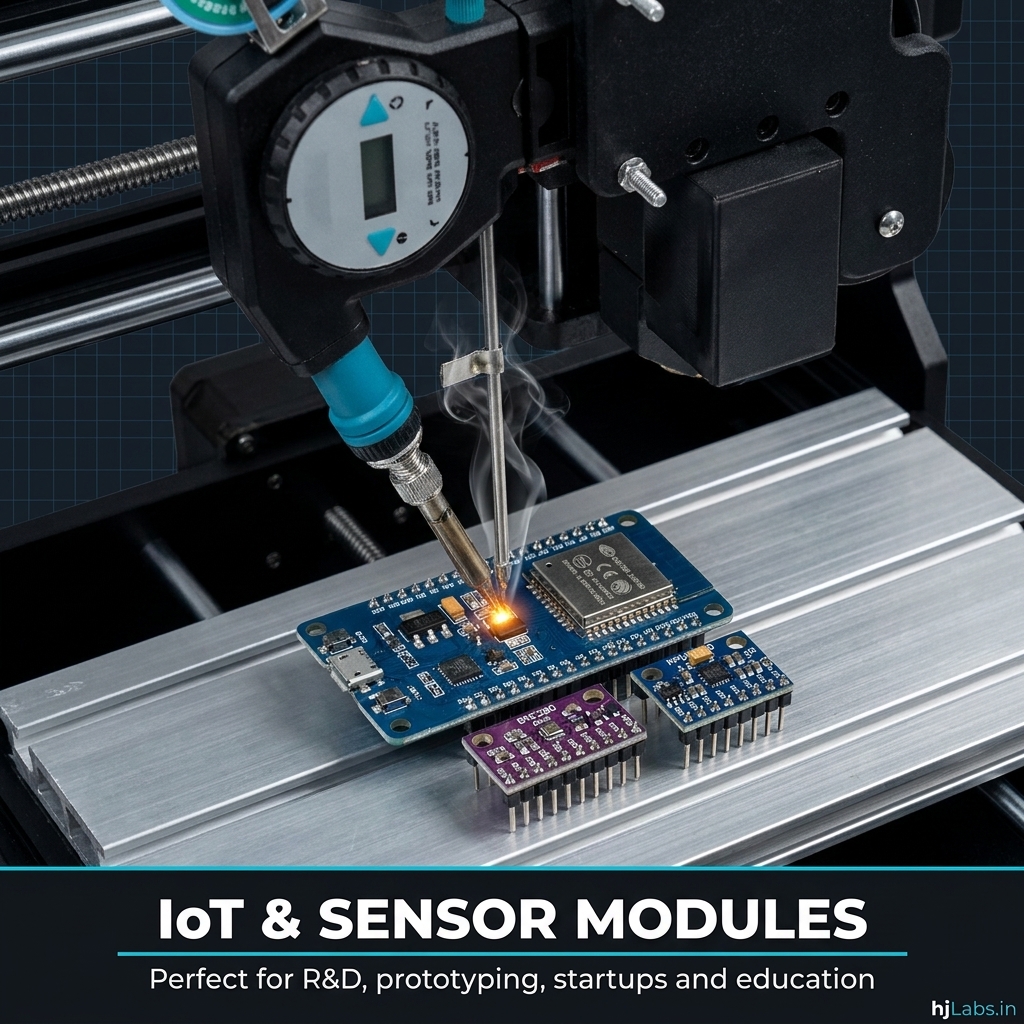
Where our 3-axis selective soldering robot replaces inconsistent hand soldering on the shop floor.
Product Description
The 3-Axis Programmable Selective Soldering Robot from hjLabs.in is engineered for shops that have outgrown hand soldering but do not want to spend ₹40 lakh on a full reflow line. It brings 0.01 mm axis repeatability, a 180 x 240 mm T-slot work bed, and a temperature-controlled iron (90-480 °C) with an automatic solder-wire feeder into one benchtop cell.
Selective soldering, teach-and-play
You do not need a CAD import or a robotics tech. Jog to a solder point with the touch-screen pendant's jog dial, save it, and the machine remembers the tip position, dwell time, wire volume, and approach angle. Programs are stored on an on-board SD card and reload automatically after a power cut — no lost programming.
Approach angles that clear tall components
Where a two-axis machine can only plunge straight down, this robot's head is programmable to four 45° approach angles plus a 90° plunge per point. That lets you solder pads recessed under connectors, next to tall capacitors, or on the bottom of a shielded module — joints that hand-soldering shops usually re-route to rework.
WiFi, OTA firmware, and web-app control
The machine is WiFi-enabled and controllable from the karmyogi.hjlabs.in web app — queue programs, monitor cycle time, and push firmware updates over-the-air. No USB cable, no rebooting into DFU mode.
Where it fits on your shop floor
Ideal for PCB assembly houses, EMS/ODM shops, battery pack builders, IoT sensor assemblers, and R&D labs shipping small-to-mid volumes. Pairs naturally with our AutoSolder 6 for high-throughput point soldering and the AutoCut V2 Wire Cutter for a complete wire-to-board cell. For a bespoke variant — larger bed, dual heads, conveyor — talk to us via Custom Automation Solutions.
What the Base Machine Includes
Everything below is part of the ₹85,000 base configuration. Nothing in this list is an add-on, and nothing in it needs a PC, a CAM seat or a separate controller cabinet.
- 3-axis gantry — industrial-grade stepper drives and lead-screw actuators on X, Y and Z, repeatable to 0.01 mm.
- 180 × 240 mm T-slot work bed — aluminium table you clamp boards, jigs and packs to directly.
- Soldering head — temperature-controlled iron, 90–480 °C, with four 45° approach angles plus a 90° plunge, programmable per point.
- Automatic solder-wire feeder — feed rate and wire volume set per joint, not per job.
- Touch-screen pendant with jog dial — the whole control system; teach-and-play programming lives here.
- Hands-free foot pedal — start and pause while both hands are on the fixture.
- On-board SD card storage — programs survive a power cut and reload automatically.
- WiFi module with OTA firmware — 2.4 GHz, driven from the karmyogi.hjlabs.in web app; updates arrive wirelessly.
Quoted separately: larger or bespoke bed sizes, dual-head configurations, integrated conveyor variants, and board-specific fixturing plates. Send us the board and the volume and we will price the variant around it rather than selling you a bigger machine than the job needs.
What It Replaces: Hand Soldering, and Where the Line Starts
This machine sits in a specific gap. Below it is a hand-soldering bench, where quality is whatever the operator’s day was like. Above it is a full selective or wave line, which is an order of magnitude more capital and only pays back at volumes most Indian EMS shops never reach. The honest comparison:
| Hand-soldering bench | This 3-axis robot | Full selective / wave line | |
| Throughput | Operator-limited; drops through a shift | 3,000–5,000 points/hr | Highest, but only on a fixed product mix |
| Joint-to-joint consistency | Varies by operator and by hour | 0.01 mm positioning, fixed dwell and wire volume per point | Process-controlled |
| Operator skill needed | High — years to train | Low — jog, save, run | Process engineer |
| Programming | None | Teach-and-play on the pendant, no CAD import | CAM / process recipe |
| Changeover between boards | Immediate | Load a saved program from SD, swap the fixture | Tooling change, often significant |
| Capital cost | Bench and iron | ₹85,000 + GST | An order of magnitude higher |
| Best fit | One-offs, rework, repair | Small-to-mid volume repeat work, mixed BOMs | High-volume single-product runs |
The practical trigger for buying one is not headcount — it is repeat work. If the same twenty joints go on the same board every week, a taught program removes the variance that hand soldering re-introduces every single time the job comes back.
How a Job Runs, Step by Step
- Fixture the board. The 180 × 240 mm bed is a T-slot aluminium table, so a clamp, a printed jig or a machined plate all bolt straight down. Repeat jobs keep their fixture, which is what makes a saved program valid the second time.
- Teach the points. Jog the head to the first joint with the pendant’s dial and save it. The machine stores tip position, dwell time, wire volume and approach angle for that point — not a global setting, a per-point one.
- Pick the approach angle. Four 45° approaches plus a straight 90° plunge are available per point. A pad recessed beside a tall electrolytic gets an angled approach; an open through-hole gets the plunge.
- Set the iron. One temperature for the program, anywhere in 90–480 °C, chosen for the alloy and the thermal mass of the joint.
- Save and run. The program goes to the on-board SD card. Start from the pendant or the foot pedal; play, pause and stop are live during the run.
- Come back to it. Next week the same program reloads from SD — including after a power cut, which is the failure mode that usually costs a shop an afternoon of re-teaching.
Solder Alloys and the 90–480 °C Range
The iron is closed-loop temperature-controlled across 90–480 °C. That single band spans every alloy family a general-purpose assembly shop runs, so switching between a RoHS job and a leaded legacy repair is a setting, not a hardware change:
- Lead-free SAC305 (Sn96.5/Ag3.0/Cu0.5) — melts around 217 °C, the default for RoHS/CE-bound product.
- Leaded eutectic Sn63/Pb37 — melts at 183 °C, still standard for defence, aerospace and legacy repair work.
- Low-temperature bismuth alloys — melt near 138 °C, used where a heat-sensitive component or a plastic housing will not survive a normal profile.
Those melting points are properties of the alloy, not of this machine; the reason they matter here is that the machine’s range comfortably brackets all three with headroom for the thermal mass of a large ground plane or a battery tab. The operator sets one temperature per program, and every joint in that program then gets the same one — which is precisely the variable a hand-soldering bench cannot hold still.
Integration on a Working Shop Floor
Network. The machine joins a 2.4 GHz WiFi network and is driven from karmyogi.hjlabs.in, the same browser workbench that runs our other machines. Firmware arrives over the air, so a fix does not mean a technician with a USB stick.
Programs as assets. Because programs live on a removable SD card, they can be copied, archived with the job traveller, and moved to a second machine when you add one. A power cut does not cost you the teach session.
Cell building. The robot pairs naturally with our AutoCut V2 wire cutter and wire and cable cutting-stripping machine to close a wire-to-board cell: cut and strip, present, solder. For the enclosure and panel side of the same product, our 3-Axis CNC Router Machine cuts front panels, cut-outs and fixture plates from the same drawing — and shares this machine’s pendant-first design philosophy, so an operator trained on one is not lost on the other.
Inspection. Where joint-level traceability is required, the machine’s fixed part position makes it straightforward to add a camera station; our computer vision for manufacturing team builds solder-joint AOI on exactly this kind of repeatable cell.
Something different? Larger beds, dual heads and conveyor-fed variants are built to order through Custom Automation Solutions.
When This Is Not the Right Machine
Selling the wrong machine costs us more than not selling one. Four cases where you should not buy this:
- Fine-pitch SMD and BGA. This is a contact point-soldering robot, not a reflow oven. Paste-printed, fine-pitch and ball-grid work belongs on a print-place-reflow line.
- Boards larger than the bed. The standard work area is 180 × 240 mm. Bigger boards need a custom bed — ask before you order, not after.
- Genuine high volume on one product. If a single board runs continuously in the tens of thousands, a dedicated selective or wave line will beat this on cost per joint despite the capital.
- One-offs and rework. Teaching a program only pays back when the job repeats. For prototype builds and repairs, a skilled hand and a good iron are still the right tools.
Price, Lead Time and Support
The base configuration is ₹85,000 + GST, built to order in Gandhinagar, Gujarat, with the lead time confirmed in writing on the quotation. Custom bed sizes, dual heads and conveyor variants are quoted separately and confirmed in writing before build starts.
Domestic shipping within India is free on orders above ₹5,000 and moves via Blue Dart, DTDC or FedEx; larger machines may go freight-on-road, which we coordinate with you directly. Full terms are on the shipping policy page.
The machine carries a 12-month warranty against manufacturing defects. Standard configurations may be returned within 7 calendar days of delivery if unused and in original packaging, with return shipping at the customer’s cost — see the return and refund policy. Because firmware updates are delivered over the air, most support fixes reach the machine without a site visit.
To get a firm number, send the board, the joint count and the annual volume through the contact form or on WhatsApp. We quote the configuration the job actually needs.
Frequently Asked Questions
Need a Custom Configuration?
Larger bed, dual heads, integrated conveyor, or a specific fixturing plate for your board — we build custom selective soldering variants.
Contact Us for Custom Enquiry