CNC Wood Router Price in India: What Actually Decides the Cost
A buyer's guide to CNC router machine prices in India — the seven components that move the price, what a quotation usually leaves out, and the questions to ask before you pay. Written by the team that builds the hjLabs.in 3-axis wood CNC router in Gandhinagar, Gujarat.
The short answer
Two CNC wood routers with the same bed size can be priced very differently, and the difference is almost never the cutting area. It is what drives the axes (belt, lead screw or ball screw), what guides them, whether the motors know their own position, the spindle and its cooling, the frame, and whether the machine needs a PC to run.
For reference, our 3-axis wood CNC router machine is ₹2,75,000 + GST, built to order, with an 850 × 940 × 95 mm work area, ball screws and LM guides on all three axes, closed-loop stepper motors and a 2.2 kW air-cooled spindle. Shipping is quoted separately by destination and weight.
The seven things that decide a CNC router machine's price
When you compare quotations, compare these line by line. A lower price is usually explained by one of them.
| Component | Lower-cost option | Higher-cost option | Why it matters |
|---|---|---|---|
| 1. Work area | Small hobby bed | Full 8 × 4 ft nesting bed | Bigger beds need a heavier frame and longer screws or racks, so cost rises faster than area. |
| 2. Axis drive | Belts or plain lead screws | Ball screws (or rack and pinion on very long axes) | Belts stretch under cutting load; lead screws have backlash when direction changes. Ball screws remove both. |
| 3. Linear guides | V-wheels or round rods | LM (recirculating-ball) linear guide rails | LM guides carry the cutting load and resist twisting, so the spindle stays square instead of deflecting into the cut. |
| 4. Motors | Open-loop steppers | Closed-loop steppers or AC servos | An open-loop stepper that loses steps does not know it. Closed-loop drives read an encoder and correct, or fault instead of scrapping the part. |
| 5. Spindle | Low-power router motor | VFD-driven spindle, 2.2 kW and up | Power decides depth of cut in hardwood. Water cooling adds a pump and lines; air cooling removes that subsystem. |
| 6. Frame | Light extrusion or thin sheet | Heavy steel, cast, or extrusion with solid machined blocks | Frame stiffness is what keeps finish and accuracy when the spindle takes a real side load. |
| 7. Control | USB board plus your own PC and software | Self-contained controller or pendant | A PC at the machine is an extra cost, an extra licence and an extra failure point in a dusty shop. |
What a CNC router quotation often leaves out
The machine price is rarely the full cost of getting a router cutting. Before comparing two quotations, check whether each of these is included, quoted separately, or not offered at all:
- GST — ask whether the price is inclusive or "+ GST". The difference is large on a machine of this value.
- Shipping and unloading — routers usually move freight-on-road. Who pays, and who unloads at your end?
- Tooling and collets — end mills, V-bits and a collet set. A machine that arrives with no cutters cannot cut anything.
- CAM or control software — is a licence needed to run the machine, and is it a one-time or recurring cost?
- The computer — if the controller needs a PC, budget for one that can live next to the dust.
- Dust extraction — wood routing produces a lot of chips and fine dust; most quotations exclude the extractor.
- Spoilboard and workholding — clamps, fixtures or a vacuum table for the parts you actually cut.
- Installation and training — is someone showing your operator how to run the first job?
- Warranty in writing — what is covered, for how long, and who pays to ship a failed part.
Spec-sheet questions to ask before you pay
- Is the bed size the actual usable travel, or the frame size? They are not the same number. Ask for X, Y and Z travel separately.
- What drives each axis? Ball screw, lead screw, belt or rack — per axis, not "for the machine".
- What are the guides? LM rails on every axis, or only some?
- Open-loop or closed-loop motors? If the seller says "servo", ask for the motor and drive make and model.
- Spindle power, cooling and drive — kW rating, air or water cooled, and whether it runs on a VFD with speed control.
- What supply does it need? Single phase 230 V or three phase changes your installation cost.
- Does it need a PC to run? And if so, which software and licence.
- Can I see it cut my material? A test cut in your own stock tells you more than any spec sheet.
Worked example: what ₹2,75,000 + GST buys on our machine
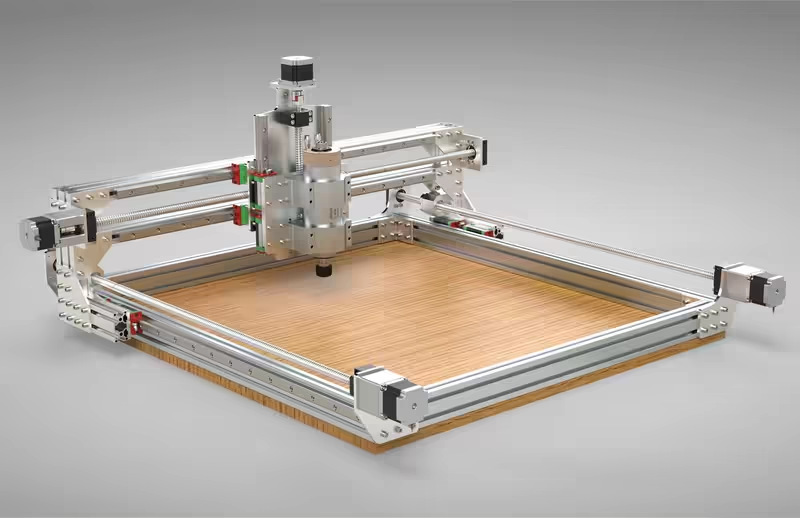
Here is how our own router answers the seven questions above, so you can use it as a benchmark against any other quotation:
| Work area | 850 × 940 × 95 mm actual usable travel (33.5 × 37 × 3.7 in) |
| Axis drive | Ball screws on X, Y and Z |
| Linear guides | LM linear guide rails on all axes |
| Motors | Rtelligent 85 kg·cm closed-loop stepper motors on all three axes; Z fitted with a holding brake |
| Spindle | 2.2 kW air-cooled spindle on a VFD with speed and direction control |
| Frame | Aluminium extrusion profile with solid machined aluminium blocks at load-bearing joints |
| Control | Handheld pendant that generates the G-code on the machine — no PC required. Optional browser control via karmyogi.hjlabs.in |
| Supply | 230 V AC, single phase, 50 Hz |
| Tooling supplied | 3–13 mm collet set and a 40-piece end mill and engraving bit set (3.175 mm shank) |
| Warranty | 12 months against manufacturing defects, per the hjLabs.in Terms & Conditions |
| Shipping | Quoted separately by destination, weight and volume — see the shipping policy |
| Lead time | Built to order; confirmed in writing on the quotation |
Final specification and suitability for a given material, cutter and fixturing are confirmed on the quotation and at pre-dispatch testing. Full details are on the 3-axis CNC router machine page.
Which bed size do you actually need?
The single biggest price jump is bed size, so size the machine to the parts you cut, not to the sheet you buy. A full 8 × 4 ft sheet needs a nesting-class machine. Most furniture and joinery shops break sheets down on a panel saw first and cut quarter and third sheets, cabinet sides, door skins and drawer components — which is the class of work an 850 × 940 mm envelope is built for.
Signage, engraved plaques, acrylic letters, pattern and mould work, and PCB or enclosure prototyping also fit comfortably in that envelope. If your panels are consistently larger, ask the maker to quote a machine around your panel size rather than buying the standard build and repositioning every job.
Buy a machine, or outsource the cutting?
If you only need CNC wood cutting occasionally, a job shop is cheaper than owning a machine. Once you are cutting repeat panels or batches every week, owning the router puts turnaround and iteration under your control. Our sister service ManufacturingHub gives an instant price for CNC wood carving and laser cutting from a DXF, SVG or STL file, which is a useful way to prototype a part before committing to in-house capacity.
Frequently asked questions
What is the price of a CNC wood router machine in India?
It depends mainly on bed size, axis drive, motor type, spindle and control system rather than on the brand name. As a reference, the hjLabs.in 3-axis wood CNC router with an 850 × 940 × 95 mm work area is ₹2,75,000 + GST, with shipping quoted separately.
Why do two CNC routers with the same bed size have very different prices?
Because the expensive parts are the ones you cannot see in a photo: ball screws versus belts or lead screws, LM guides versus V-wheels, closed-loop versus open-loop motors, spindle power and cooling, frame stiffness, and whether a PC and software licence are needed to run it.
Is GST included in CNC router prices?
Not always. Many quotations are "+ GST". Always ask whether the figure is inclusive or exclusive before comparing two machines. Our router is priced at ₹2,75,000 + GST.
Does a CNC router need a computer to run?
Many do — the controller is driven from a PC running control software. Ours does not: the handheld pendant generates the G-code on the machine, and a browser workbench is available as an option.
Is a ball screw CNC router better than a belt-driven one?
For wood routing under real cutting load, ball screws hold position better: belts stretch under load and lead screws show backlash on direction changes. Belt drives are common on lighter, lower-cost machines.
Can a 3-axis CNC router cut a full 8 × 4 ft sheet?
Only if its bed is that large, which puts it in a much higher price class. A machine with an 850 × 940 mm envelope cuts cut-down blanks, which is how most joinery shops work anyway.
Get a firm quotation
Tell us the panel size you cut, the materials, and whether you need custom fixturing, and we will quote the machine around your work.